
Pleasanton vs. Danville, Alamo & Diablo: 2026 Luxury Home Comparison
East Bay Luxury Real Estate & Regional Market Advisory
If you are sitting on substantial equity in a well-located Pleasanton home and considering a move up into Danville, Alamo, or Diablo, you are doing more than changing ZIP codes—you are shifting into distinct micro-markets across the Alameda and Contra Costa county line. Each of these premier East Bay communities operates on its own economic logic: unique school feeder dynamics, radically divergent lot scales, contrasting commute tolerances, and differing property tax assessments.
This comparative guide breaks down how these four luxury markets evaluate capital at the $2.0M to $5.0M+ price point, so you can structure your next acquisition with verified empirical data rather than speculative marketing assumptions.
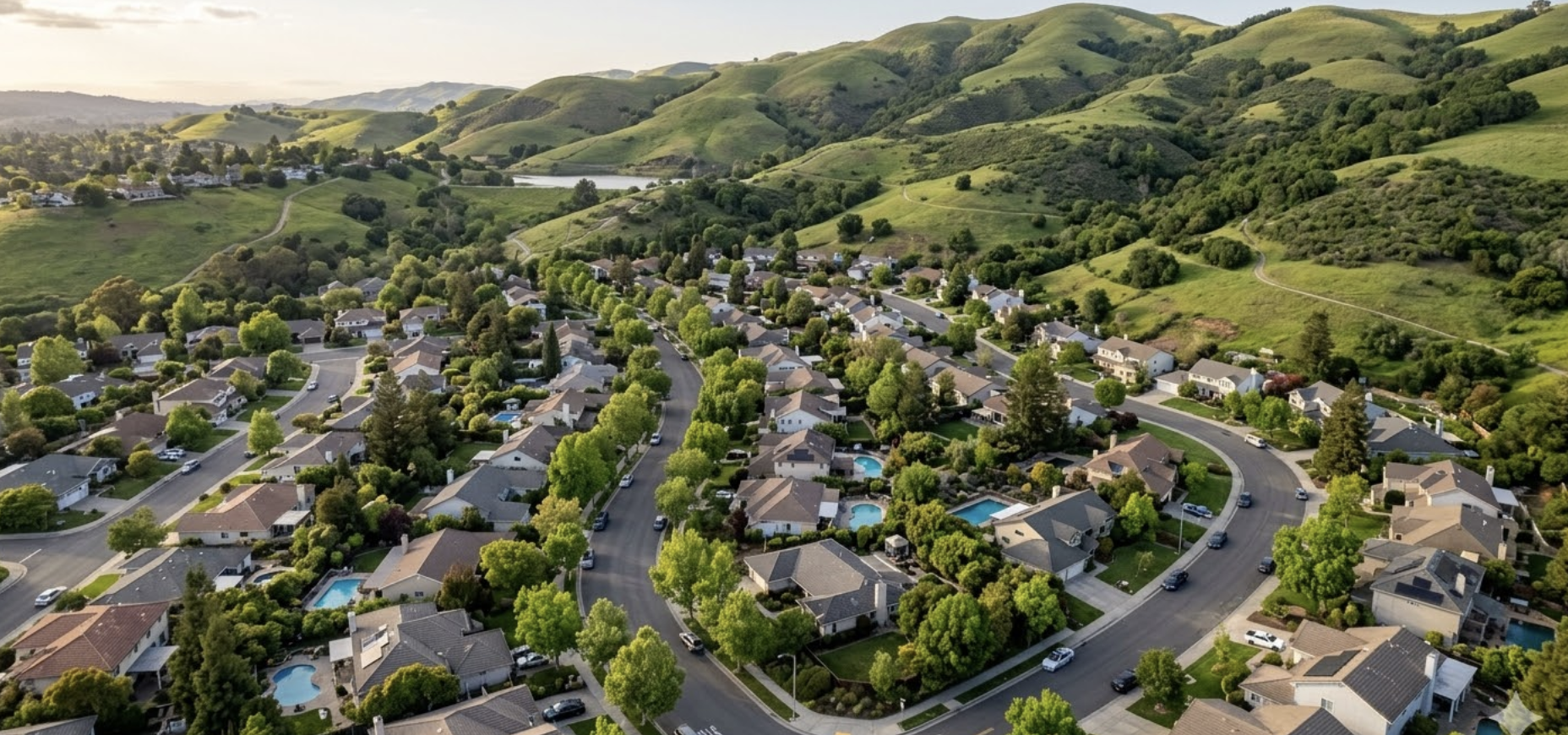
Direct Answer: The fundamental choice between Pleasanton and its Contra Costa luxury neighbors—Danville, Alamo, and Diablo—comes down to transit connectivity versus private land acreage. In 2026, Pleasanton ($1.85M median luxury baseline; $2.8M–$5.5M in Ruby Hill) offers superior mass transit infrastructure (dual BART stations + ACE Rail to Silicon Valley), a walkable historic Main Street, and top-tier public schools (PUSD) on manicured 0.20 to 0.35-acre lots with zero Mello-Roos CFD taxes. Danville (median $1.9M–$3.2M) provides charming village dining along Hartz Avenue and high-performing SRVUSD schools on 0.25 to 0.50-acre lots, but requires car-dependent highway commuting. Alamo (median $3.1M, up 8.1% YoY) and Diablo ($3.5M–$7.0M+) offer expansive 0.50 to 1.5+ acre flat parcels, equestrian estates, and private golf seclusion, trading transit access for maximum privacy and prestige.
Four-Market Comparison: Pleasanton, Danville, Alamo & Diablo
How the primary luxury enclaves of the southern and northern I-680 corridor compare across pricing, physical acreage, school feeders, and tax structures:
What a $2M to $3M Budget Actually Buys in Each Market
At the $2.0M threshold, the purchasing experience varies dramatically depending on which side of the county line you target:
- In Pleasanton: A $2.0M budget secures a modernized 2,800 to 3,600 sq. ft. executive residence in coveted central neighborhoods like Vintage Hills, Del Prado, or Birdland on a landscaped 0.20 to 0.25-acre lot with zero HOA dues and zero Mello-Roos CFD taxes. Moving to $2.5M–$3.0M unlocks custom single-story ranches or gated estates in Ruby Hill. Review our analysis: $2M vs. $2.5M Pleasanton Luxury Homes: What That Extra $500K Buys.
- In Danville: $2.0M places you in a highly competitive bracket, typically yielding a 2,400 to 3,000 sq. ft. 1970s–1980s ranch or two-story home in Westside Danville or near Greenbrook. While full of architectural charm, homes at this tier often require cosmetic remodeling to reach contemporary luxury standards.
- In Alamo: $2.0M represents an entry-level threshold, primarily capturing smaller single-level properties on busy transit arterials or original mid-century homes requiring extensive structural overhauls. True turn-key Alamo luxury estates with 0.5+ acres now command $3.1M to $5.5M+.
- In Diablo: Inventory below $3.0M is virtually nonexistent. The market consists almost entirely of custom multi-million dollar estates surrounding Diablo Country Club trading between $3.5M and $7.0M+.
For a deeper look at carrying cost variances at this price point, see our three-city breakdown: What $2M Buys in Pleasanton vs. San Ramon vs. Danville.
Schools: PUSD vs. SRVUSD Feeder Patterns
Both the Pleasanton Unified School District (PUSD) and the San Ramon Valley Unified School District (SRVUSD) rank among the top public school systems in California. In academic outcomes, college matriculation, and AP test performance, both districts are exceptional:
Pleasanton Unified (PUSD)
Campuses: Foothill High School and Amador Valley High School.
PUSD provides balanced excellence with 70%+ math proficiency, nationally recognized music and robotics programs, and athletic championships. Both high schools are integrated directly into the city's residential fabric, allowing students in neighborhoods like Birdland and Del Prado to walk or bike to school.
San Ramon Valley Unified (SRVUSD)
Campuses: Monte Vista High (Alamo/Danville) and San Ramon Valley High (Danville).
Monte Vista and SRVHS consistently rank in California's top 5%, characterized by intense academic rigor and strong community involvement. Because parcels in Alamo and Westside Danville span large acreages, students rely almost exclusively on personal vehicles or family carpools for transit.
For families also evaluating independent prep options across both counties, review our comprehensive directory: Top Private Schools Near Pleasanton & The Tri-Valley (Quarry Lane, Athenian & BASIS).
Commute Reality: BART & ACE Rail vs. The I-680 Corridor
Pleasanton’s most significant structural advantage over Danville, Alamo, and Diablo is multi-modal mass transit connectivity:
- San Francisco BART Transit: Pleasanton features two stations (Dublin/Pleasanton and West Dublin) delivering a direct ~48-minute train ride to Embarcadero. For corporate hybrid workers required in-office 3 days a week, this eliminates Bay Bridge traffic uncertainty. Danville, Alamo, and Diablo have no direct rail access; commuters must drive 10 to 20 minutes north to Walnut Creek or south to Dublin just to reach a platform.
- Silicon Valley ACE Rail Advantage: The Downtown Pleasanton ACE Rail train connects tech workers directly to Great America in Santa Clara (~45 mins) and San Jose Diridon (~55 mins), bypassing the I-680 Sunol Grade bottleneck. Contra Costa residents cannot access rail transit south into Silicon Valley without driving to Pleasanton first.
- I-680 Highway Chokepoints: Driving south from Alamo or Danville toward Silicon Valley adds 20 to 35 minutes of daily congestion at the Bollinger Canyon and Sunol Pass interchanges during peak morning hours.
To examine how different neighborhoods position relative to commute on-ramps, read: The Best Pleasanton Neighborhoods for Silicon Valley Commuters.
Lot Size and Privacy: Where Alamo and Diablo Pull Ahead
If your non-negotiable priority is sprawling outdoor grounds—such as a private vineyard, detached guest casita (ADU), multi-stall equestrian barn, or full-scale athletic court—Alamo and Diablo provide an estate scale that standard Pleasanton tracts cannot match:
- Alamo & Diablo Acreage: Parcels routinely span 0.50 to 1.5+ acres of flat, usable land with deep setbacks from neighboring homes, mature heritage oak groves, and private gated motor courts.
- Standard Pleasanton Lots: Resale neighborhoods in Pleasanton average 0.20 to 0.35 acres (8,000 to 15,000 sq. ft.). While generous compared to high-density Dublin master plans, they are suburban parcels rather than country estates.
- The Pleasanton Alternatives for Acreage: Buyers who want Alamo-style acreage without sacrificing Pleasanton’s schools or BART transit focus on two specific enclaves:
- Ruby Hill: Custom estates on flat 0.35 to 0.75-acre lots with 24/7 guarded security. Read: Is Ruby Hill Worth It for Non-Golfers?
- Castlewood: Wooded foothill estates offering 0.50 to 2.0+ acres of secluded hillside privacy. Review: Ruby Hill vs. Castlewood HOA fees and costs.
How to Structure the Move-Up Without Creating a Financial Gap
The most common mistake sellers make when moving up from Pleasanton to Danville or Alamo is treating the sale and purchase as separate, disconnected transactions. In a market where luxury sellers reject home-sale contingencies, timing misalignment forces buyers into rushed purchases or double moves.
- Deploy Bridge Financing or Home Equity Liquidity: Leveraging cross-collateralized bridge financing allows you to buy your replacement Danville or Alamo home first as a non-contingent cash-equivalent offer, move at your own pace, and prep your Pleasanton home for maximum market value. Read our strategy memo: Sell First or Bridge Financing in Pleasanton Luxury.
- Audit California Proposition 19 (Age 55+): If you or your spouse are 55 or older, you can transfer your existing low Proposition 13 property tax base across county lines from Alameda County to Contra Costa County up to three times. Consult our guide on Pleasanton property taxes and Proposition 19.
- Manage Capital Gains Exposure: Long-held Pleasanton homes carry substantial equity above the $500,000 Section 121 exclusion. Review our calculation guide: Capital Gains Tax on Selling a Pleasanton Home.
Strategic Recommendation: Which Market Fits Which Buyer?
- Choose Pleasanton If: You value multi-modal rail transit to San Francisco and Silicon Valley, love historic downtown walkability, prefer zero HOA dues in established neighborhoods, and want top-ranked PUSD schools on manageable 0.25-acre lots. Learn more in our Complete Guide to Moving to Pleasanton CA.
- Choose Danville If: You desire historic village dining along Hartz Avenue, seek tighter-knit suburban community traditions, and are comfortable with a car-dependent highway commute along I-680.
- Choose Alamo If: You are deploying $3M to $5M+ to secure a flat 0.50 to 1.0+ acre private estate with private gates, equestrian amenities, or custom pool grounds that cannot physically exist on the Pleasanton valley floor.
- Choose Diablo If: You seek ultra-exclusive country club heritage, multi-generational privacy, and historic estate grounds in a secluded unincorporated enclave.
To understand how broader economic trends are impacting pricing floors across these cities, read our analysis on how tech layoffs and AI wealth are affecting Tri-Valley property values, and see Why Luxury Homes in Pleasanton Are a Smart Investment.
Frequently Asked Questions
How do luxury home prices compare across Pleasanton, Danville, Alamo, and Diablo?
In 2026, baseline luxury pricing varies by market: Pleasanton's executive single-family segment trades from $1.85M to $2.8M (with custom estates in Ruby Hill reaching $2.8M–$5.5M+); Danville luxury homes average $1.9M to $3.2M (with Blackhawk estates spanning $2.5M–$5M+); Alamo represents an elevated prestige tier with a median of $3.1M and custom properties regularly exceeding $5M; and Diablo is the most exclusive enclaved tier with homes clustering between $3.5M and $7.0M+.
What are the key lot size differences between Pleasanton and Alamo/Diablo?
Pleasanton's established luxury neighborhoods typically offer 0.18 to 0.35-acre lots (8,000 to 15,000 sq. ft.), with gated communities like Ruby Hill and Castlewood providing 0.35 to 0.75+ acres. In contrast, Alamo and Diablo are renowned for true semi-rural estate acreage, where residential parcels routinely range from 0.50 to 1.5+ acres of flat, usable land accommodating private vineyards, tennis courts, and detached guest casitas.
How do school districts compare: Pleasanton Unified (PUSD) vs. San Ramon Valley Unified (SRVUSD)?
Both districts rank among Northern California's top 5%. Pleasanton Unified (PUSD) serves Pleasanton via Foothill High School and Amador Valley High School, known for strong academic balance, walking-distance neighborhood access, and 70%+ math proficiency. San Ramon Valley Unified (SRVUSD) serves Danville, Alamo, and Diablo via Monte Vista High and San Ramon Valley High, known for elite academic test metrics and intense college preparatory tracks. Both districts provide exceptional resale value floors.
What is the commute trade-off between Pleasanton's BART access and the Contra Costa corridor?
Pleasanton holds an unmatched structural transit advantage with dual BART stations providing a ~48-minute direct rail commute to Downtown San Francisco, alongside the ACE Rail train connecting directly to Silicon Valley (Santa Clara/San Jose) in ~45 minutes. Danville, Alamo, and Diablo are car-dependent markets requiring a 10-to-20-minute drive to reach rail transit, and face significant highway congestion along the I-680 corridor during morning and evening rush hours.
Does Alamo or Diablo have lower property taxes than Pleasanton?
Property taxes across all four communities are governed by California's Proposition 13, establishing a base ad valorem tax rate of approximately 1.0% to 1.2% of assessed value (which resets to the purchase price upon acquisition). Established neighborhoods in Pleasanton, Danville, Alamo, and Diablo are exempt from modern Mello-Roos CFD taxes. The total property tax obligation depends strictly on your purchase price rather than municipal boundaries.
How does Castlewood or Ruby Hill in Pleasanton compare to Alamo acreage?
Ruby Hill delivers flat 0.35 to 0.75-acre parcels within an exclusive 24/7 guarded security perimeter and a Jack Nicklaus golf setting, offering managed security that Alamo's open roads do not provide. Castlewood provides wooded hillside acreage (0.5 to 2.0+ acres) with rustic topography and golf club amenities similar to Diablo, but with faster proximity to Pleasanton's retail center and I-680 on-ramps.
What is the wildfire insurance risk in Alamo, Diablo, and western Pleasanton?
Hillside and open-space-adjacent parcels in Alamo (94507), Diablo, the Danville foothills (94506), and Pleasanton's western ridgeline/Castlewood sit within state-designated Wildland-Urban Interface (WUI) zones. Standard private carriers frequently decline new coverage in these pockets, requiring buyers to combine the California FAIR Plan with a Difference in Conditions (DIC) policy, which runs $4,000 to $8,500+ annually. Valley floor parcels in central Pleasanton and Danville retain standard private carrier eligibility.
How should homeowners structure a move-up between Pleasanton and Danville/Alamo without carrying two mortgages?
Move-up buyers should utilize modern bridge financing or cross-collateralized home equity liquidity rather than submitting home-sale contingent offers, which luxury sellers routinely reject. Bridge loans allow you to tap accumulated Pleasanton equity to submit a non-contingent cash-equivalent offer on your replacement property in Danville or Alamo, complete your move, and then stage and sell your existing home for maximum market value.