Are Tech Layoffs Actually Hurting Your Tri-Valley Home's Value — Or Is That the Wrong Question?
Every week I talk to Tri-Valley homeowners who have read the same headline — Bay Area home prices fell 3.2% — and concluded their home is worth materially less than it was a year ago. In most cases, they are wrong. But the reason they are wrong is more important than the correction itself: the Bay Area is not one market. Alamo's median home price rose 8.1% year-over-year to $3.1 million in March 2026. San Ramon's fell 10.9%. Both facts are true. Understanding which one applies to your address is the entire ballgame.
This guide is built for current Tri-Valley homeowners running a risk assessment — not yet ready to list, but trying to understand whether the tech sector contraction has materially impaired their equity, and whether demand from AI-adjacent wealth can replace what departing Workday and Salesforce workers remove from the buyer pool. My answers are drawn from transaction experience in this specific geography, not from national trend dashboards.
How Have Tech Layoffs Actually Affected Tri-Valley Home Prices?
Tech layoffs have applied selective pressure on Tri-Valley mid-market prices without triggering broad declines. The damage is concentrated in the $1.2M–$1.8M price band, where the primary buyer is a mid-to-senior tech worker — precisely the demographic most exposed to 2025–2026 layoff cycles.
Since November 2022, Bay Area luxury homes priced between $3.1M and $7.6M have appreciated 13.4%, driven by AI sector wealth creation. In the same period, homes priced below $615,000 have declined 3.8%. The Tri-Valley — median prices ranging from $1.1M in Livermore to $3.1M in Alamo — sits across this dividing line, which is why submarket specificity matters far more than any regional headline.
Here is what the numbers actually say at the city level as of March 2026:
The K-shape is not a theory. It is visible in the data at the zip-code level. Homeowners who hold assets in Alamo (94507) and upper Danville (94526) are experiencing a fundamentally different market than a condo owner in East Dublin (94568).
What Did the Workday Layoffs Specifically Do to Pleasanton's Housing Market?
Workday's Pleasanton layoffs directly removed high-income buyers from Pleasanton's own residential market. The company filed WARN notices for 617 Pleasanton-location employees in 2025 and an additional 154 Pleasanton employees in early 2026 — a total of 771 documented local job cuts in 18 months.
This is the insider nuance that aggregate market reports miss entirely. Workday is not a distant employer whose layoffs arrive as a statistical abstraction. It is headquartered on Stoneridge Mall Road in northern Pleasanton. Its employees live in the Val Vista, Vintage Hills, and Neal subdivisions that constitute Pleasanton's most active resale neighborhoods. When 617 workers lose their jobs in the same quarter, some fraction of them stop being buyers. Some become reluctant sellers.
In my experience working with sellers in central Pleasanton through this period, the effect was measurable but not catastrophic. Days on market stretched from roughly 12 days to 25 days. Sellers who priced at peak 2024 comps encountered more price negotiations than they expected. But Pleasanton's structural floors — Amador Valley High School's attendance premium, walkable downtown on Main Street, dual BART station access, and a diversified employment base including the Hacienda Business Park — prevented the kind of demand vacuum that would produce a true correction.
For homeowners considering a listing, the actionable implication is this: price to where Pleasanton buyers actually are in spring 2026, not where they were in spring 2024. The 99% of list-price close rate I am seeing in well-prepared Pleasanton homes tells me the market is normalizing, not collapsing. The window for above-asking outcomes is narrowing, not closed.
Is Now a Good Time to Sell a Tri-Valley Home, or Should I Wait for Rates to Drop?
The sell-now-vs.-hold decision hinges on three variables specific to your situation — not on a macro rate forecast. Those variables are: your retirement or relocation timeline, your equity position relative to your target purchase, and whether your home sits in an insurance risk zone that will become harder to sell after October 2026.
The most common misconception I hear from homeowners who choose to hold is that holding is risk-free. It is not. Holding extends your exposure to three converging cost pressures in the current environment.
First, deferred maintenance compounds. Tri-Valley homes built in the 1970s through 1990s — which represent the dominant resale stock in Pleasanton, Danville, and Livermore — are increasingly revealing foundation drainage issues, aging HVAC systems, and pipe conditions that require remediation. Each year of holding is a year of potential deferred-maintenance accumulation that will surface in a pre-listing inspection or buyer's contingency exercise.
Second, insurance costs are rising fast and front-loaded for hillside properties. The California FAIR Plan, which is the insurer of last resort for properties that cannot obtain private coverage, announced a 30% average rate increase effective October 15, 2026. If your home is in a hillside zone in Alamo, San Ramon foothills, or Blackhawk, that increase directly raises the cost basis for any buyer who must rely on FAIR Plan coverage — which is itself a negotiating friction point that did not exist in 2022.
Third, inventory is rising. Spring 2026 Tri-Valley inventory is up approximately 24% year-over-year. More competition is not a catastrophic development, but it does mean that homes requiring preparation are sitting longer while well-staged, pre-inspected listings continue to move efficiently.
For move-up buyers specifically, the lock-in effect cuts both ways. If you are selling a Pleasanton home at 3.2% to buy a Danville home at 6.2%, your rate penalty is real — approximately $3,000 more per month on a $1.8M purchase versus the same mortgage in 2021. But that penalty applies equally to your competition. Move-up buyers who can deploy 40% or more down on the new property reduce their rate sensitivity materially. AI-sector employees with vested equity are well-positioned for this math. Legacy tech employees with illiquid RSUs are not.
What Is the True Monthly Cost of Owning a Home in Dublin vs. Pleasanton?
A $1.3M Dublin new-construction home can cost $600 or more per month beyond what Zillow's payment estimator displays, primarily because Mello-Roos special taxes and HOA fees are not included in portal calculations. When full monthly cost is calculated, some Pleasanton resale homes priced $200K higher than Dublin new construction carry lower effective monthly obligations.
This is the most consequential gap in the information that buyers bring to their first offer. Dublin's East Dublin planned communities — the neighborhoods developed from the early 2000s onward along Fallon Road, Tassajara Road, and the Jordan Ranch corridor — were financed through Community Facilities Districts. Every parcel in these CFDs carries an annual Mello-Roos obligation that runs alongside property taxes and does not disappear when you refinance. Amounts vary by neighborhood phase and typically range from $1,000 to $4,000+ per year, with annual escalation clauses built into most formation documents.
Before making an offer on any Dublin property — or any newer San Ramon property in the Gale Ranch or Windemere developments — request the Preliminary Title Report and ask specifically for the CFD formation documents. Do not rely on MLS disclosures alone; Mello-Roos obligations are listed in the NHD (Natural Hazard Disclosure) and title report, not always in the MLS data field.
The calculation reveals a localized variance pattern: a $646/month variance floor — meaningful, but far less dramatic than the raw $200,000 sticker gap implies. Furthermore, the Pleasanton buyer locks in premium PUSD school zoning, walkable downtown lifestyle paths, and an established lot footprint unburdened by a structural Mello-Roos infrastructure lien that would complicate a future resale timeline.
For buyers weighing Livermore as an alternative, the calculus shifts further. A comparable home in Livermore at $1.1M — with minimal Mello-Roos exposure in older established neighborhoods — carries a full monthly cost approximately $1,500–$2,000 less than the Dublin equivalent, with a traffic-independent ACE train commute to Santa Clara that takes 55 minutes. Livermore is not "just cheaper Dublin." It is a structurally different value proposition for buyers whose employers are on the Santa Clara/San Jose corridor.
What Is the California FAIR Plan and Should Tri-Valley Homeowners Be Worried?
The California FAIR Plan is the state-mandated insurer of last resort for properties that private carriers have declined to cover. In 2026, homeowners in Tri-Valley hillside zones — including Alamo (94507), Danville foothills and Blackhawk (94506), and portions of San Ramon foothills — are increasingly reliant on FAIR Plan coverage after private insurers withdrew from these fire-risk areas. A 30% average rate increase takes effect October 15, 2026.
For sellers, insurance cost is becoming a buyer-facing negotiating variable in a way it was not in 2021 or 2022. A buyer who secures FAIR Plan coverage for a hillside Alamo property at $5,200 per year and then learns that coverage will increase 30% in October is facing a $1,560 annual cost increase that was not in their budget model. Some buyers are using this as a negotiating lever. Some are walking away from hillside properties entirely and redirecting to valley floor alternatives in central Pleasanton or Dublin.
My recommendation for any seller in a hillside zone: obtain your own insurance quote before listing, disclose it proactively, and price with the October increase already factored into buyer cost calculations. Sellers who wait until after October 15 to list hillside properties will face a buyer pool that has already absorbed the new baseline — which is less friction than presenting a buyer with a surprise mid-escrow.
Valley floor properties in central Dublin, central Pleasanton, and central San Ramon retain standard private insurance availability. Insurance due diligence should happen before an offer is made, not after. Ask your agent for the parcel's VHFHSZ (Very High Fire Hazard Severity Zone) designation from CAL FIRE — it takes five minutes and can save weeks of escrow disruption.
Which Tri-Valley City Holds Value Best During a Tech Downturn?
Alamo and Danville have demonstrated the strongest value stability during the 2025–2026 tech contraction, because their buyer pools are disproportionately composed of executives, equity holders, and business owners rather than salaried tech employees who face layoff exposure. Livermore has shown structural stability driven by federal employer anchors that are immune to private-sector cycles.
The employer-to-neighborhood mapping is the framework I use when advising clients on which assets to hold and which to reposition. San Ramon Valley Unified School District serves Alamo, Danville, and western San Ramon — Monte Vista High School's top-5% California ranking is the single largest identifiable value driver for properties in those attendance zones. Homeowners in SRVUSD areas benefit from a school-premium floor that exists independently of any single employer's fortunes.
Pleasanton is more nuanced. PUSD (Amador Valley and Foothill High Schools) provides a comparable school-premium floor, but Workday's concentration in northern Pleasanton has measurably compressed the buyer pool for homes in the Val Vista and Neal subdivision areas closest to that campus. Homes in Pleasanton's downtown core and Castlewood area — where the buyer tends to be a business owner or regional executive rather than a Workday employee — have shown considerably more resilience.
For investors specifically, the K-shape dynamic argues for holding luxury assets in Alamo and upper Danville while reducing exposure to entry-tier condos in East Dublin, where demand erosion from mid-level tech worker displacement is most acute.
What Is the Realistic Commute From the Tri-Valley to Silicon Valley and San Francisco?
Peak-hour commutes from Tri-Valley cities to San Francisco range from 65 to 105 minutes by car. The ACE train provides a traffic-independent alternative from Livermore and Pleasanton to Santa Clara in approximately 55 minutes — the most underused commute asset in the Tri-Valley for southbound tech workers.
Google Maps ideal-time estimates are systematically misleading for Tri-Valley buyers running commute scenarios. Add 25 to 35 minutes to any off-peak estimate for morning rush to San Francisco (6:30–9:30 AM) or Silicon Valley. Pleasanton to SF via I-680N and I-580W runs 75 to 90 minutes at peak. Dublin to SF via I-580W runs 65 to 80 minutes. The Caldecott Tunnel creates an additional bottleneck on the San Ramon to SF corridor that is not visible in navigation app estimates.
BART from Dublin/Pleasanton station to Embarcadero runs approximately 60 minutes with no traffic dependence — and Dublin's dual BART stations (Dublin/Pleasanton and West Dublin/Pleasanton) make it the highest-transit-access city in the Tri-Valley. For buyers whose employer is in the SF Financial District or SoMa, Dublin's BART walkability translates to a material commute advantage over San Ramon or Danville, despite a lower sticker price.
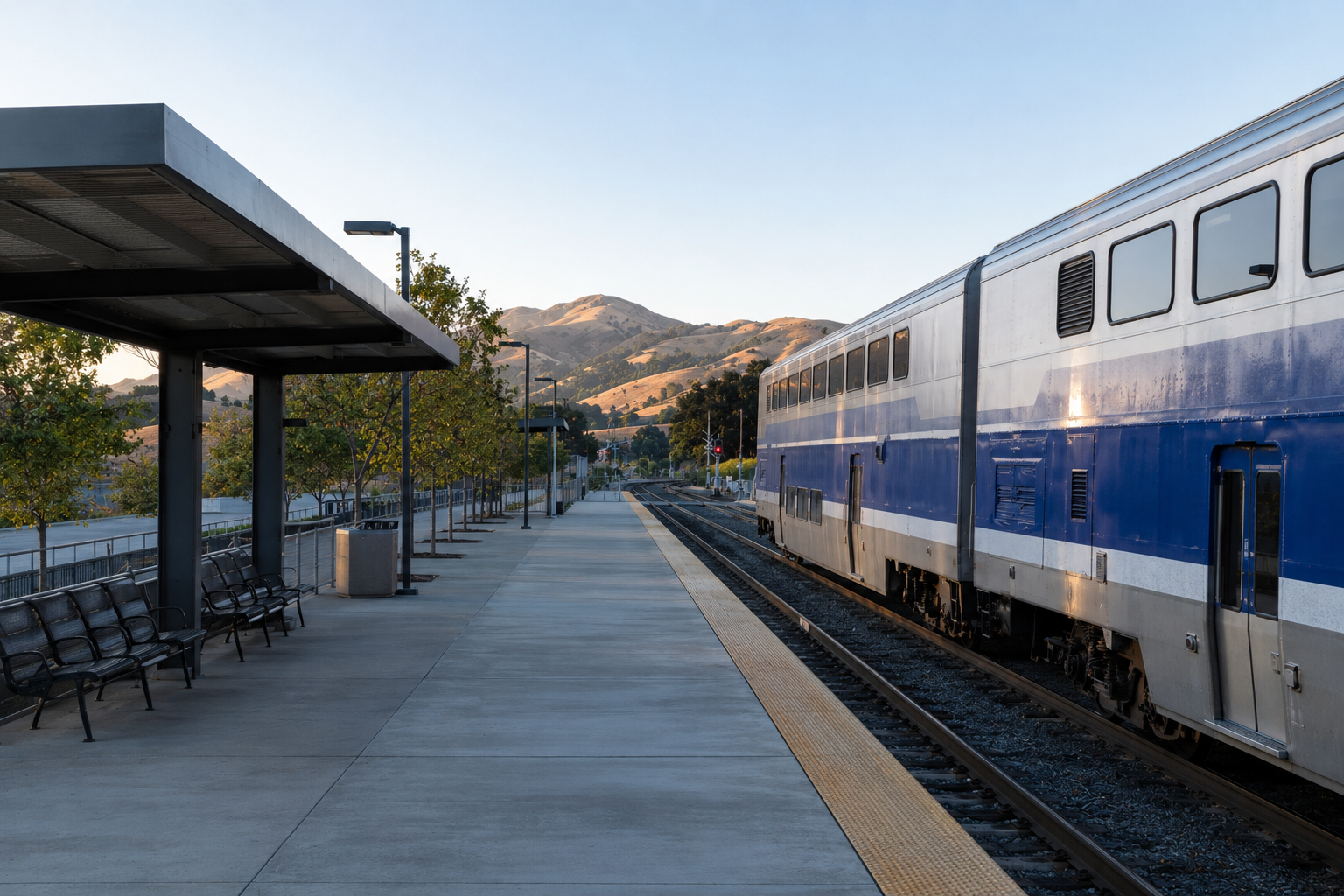
For buyers with Silicon Valley employers — NVIDIA Santa Clara, Apple Cupertino, Google Mountain View — the ACE train is the calculus-changing variable that most buyers overlook. Four weekday round trips operate daily from Livermore and Pleasanton, stopping at Fremont, Great America (Santa Clara), and San Jose. The route connects directly to campus shuttle pickup points at Great America. A buyer who pays $200,000 to $450,000 less for an equivalent home in Livermore versus Pleasanton, and commutes by ACE rather than driving, recovers that price differential in approximately 8 to 15 years through purchase price alone — before accounting for the absence of driving stress and Mello-Roos obligations.
What Are the Top Reasons a Tri-Valley Luxury Home Sale Falls Apart in 2026?
The five most common deal-failure mechanisms in the Tri-Valley in 2026 are: layoff-triggered financing fallout mid-escrow, appraisal gaps caused by stale Q4 2025 comps in low-volume luxury sub-markets, insurance denial for hillside parcels, inspection contingency exercises on pre-1985 homes with deferred maintenance, and title-review discovery of undisclosed CFD obligations.
Pre-listing inspections are the single highest-ROI investment a Tri-Valley seller can make in this market. At $600 to $1,200, a pre-listing inspection eliminates the highest deal-failure risk — buyer inspection contingency exercises account for approximately 60 to 70% of failed Tri-Valley transactions in 2026. Homes built before 1985, which represent the dominant stock in Pleasanton, Danville, and Livermore, frequently reveal foundation drainage issues, galvanized pipe, or HVAC systems that buyers use to renegotiate or exit. Discovering these items before listing — and either remediating them or disclosing them with contractor bids — produces dramatically more predictable close rates.
Appraisal gaps are the second emerging risk. Low transaction volume in Q4 2025 means appraisers working on spring 2026 listings are using sparse, lower-price comps from a slower period. Properties in Alamo and Danville, where monthly sales volume runs 25 to 35 homes, are particularly exposed to stale-comp undervaluation. Sellers should prepare an appraisal support package — recent upgrades, comparable sales with adjustments, and neighborhood market narrative — and provide it to the listing agent before the home goes live. This is proactive risk management, not price justification after the fact.
Rate lock expiry creates a less visible but increasingly common deal failure. Standard 30-day rate locks are frequently insufficient when appraisal delays and underwriting extend timelines past 45 days. Buyers who let locks expire face re-pricing at current rates, which can alter qualification math enough to terminate a transaction. Buyers should ask lenders about 45 or 60-day rate lock options at the outset, particularly on properties in low-volume sub-markets where appraisal scheduling runs long.
Is AI Wealth Creation Real Enough to Replace Tech Layoff Demand in the Tri-Valley?
AI sector wealth is real and concentrated in the luxury tier above $3.1M, which directly benefits Alamo and upper Danville. It does not materially replace legacy tech buyer demand in the $1.2M–$1.8M range, where the buyer pool is still primarily mid-to-senior salaried tech workers — a demographic that AI equity windfalls have not yet reached in meaningful numbers.
The misconception is that "tech workers" are a monolithic cohort. In practice, the 2026 Tri-Valley buyer pool has bifurcated. AI sector employees at companies with significant equity appreciation — OpenAI, Anthropic, and adjacent firms — represent an emerging luxury buyer cohort with genuine purchasing power in the Alamo and upper Danville price range. Legacy tech employees at Workday, Salesforce, HP, and Autodesk — the companies executing the current layoff wave — face material displacement risk and represent the suppressed mid-market demand that is driving the K-shape dynamics visible in the data.
For homeowners in the $1.5M–$2.5M range — the contested middle where neither the AI wealth lift nor the legacy tech displacement fully dominates — the outcome will be determined by the pace of AI equity monetization relative to the depth of the current layoff cycle. My read of the current market is that this segment remains liquid, but pricing discipline matters more than it did in 2021. Homes priced to the market close efficiently. Homes priced to seller expectations from 2024 peak comps are sitting 40 to 60 days and ultimately conceding the same price with more friction.
Categories
Recent Posts