Ruby Hill vs. Castlewood vs. The Preserve: Pleasanton Luxury Enclave Comparison (2026 Guide)
Pleasanton Luxury Enclave & Community Advisory
Three neighborhoods. One price band. Radically different daily lives. In Pleasanton real estate, Ruby Hill, Castlewood, and The Preserve represent the core choices at the $2.0M to $5.0M+ level—but they are not interchangeable. Each enclave is engineered around a distinct lifestyle philosophy, and choosing the wrong community carries high friction and substantial transaction costs to reverse.
Below is the objective, numbers-first evaluation framework I walk through with clients who have narrowed their search to these three flagship communities.

Direct Answer: The fundamental choice among Pleasanton's premier luxury enclaves comes down to security, topography, and club culture: (1) Ruby Hill ($2.8M to $5.5M+) is Pleasanton's only 24/7 guard-gated golf community, featuring flat, usable 0.35 to 0.75-acre lots, resort country club amenities, and direct zoning to Amador Valley High School with master HOA dues of $255–$310/mo (up to $800/mo in sub-HOAs); (2) Castlewood ($2.0M to $4.5M+) offers secluded, wooded hillside acreage (0.50 to 2.0+ acres) surrounding a historic 36-hole country club without a manned gate, zoned for Foothill High School with minimal road dues (~$62.50/mo), but requires budgeting $5,000–$12,000/yr for California FAIR Plan fire insurance; and (3) The Preserve ($2.4M to $3.8M+) provides modern custom builds with panoramic ridge views, immediate trailhead access to Pleasanton Ridge Regional Park, automated gate access, and Foothill High School zoning without country club overhead.
Head-to-Head Comparison: The 2026 Enclave Matrix
How the three communities stack up across pricing, gate security, parcel topography, school feeder tracks, and monthly carrying overhead:
Gated vs. Non-Gated: More Than a Security Question
Physical gate infrastructure dictates your household’s daily operational friction—for visiting guests, delivery drivers, contractors, and your own entry:
- Ruby Hill (24/7 Guard Staffing): Features dual manned security gatehouses (Ruby Hill Blvd and Vineyard Ave). Live guards log incoming vehicle license plates, enforce tailgating rules, and admit pre-registered guests. For relocating corporate executives, this physical security perimeter provides unparalleled peace of mind. Review closed sales inside the gates in our Ruby Hill Sales Record & Comps Dossier.
- Castlewood (Topography & Private Roads): Has no security gatehouse. Privacy is achieved through winding ridgeline topography and private road spurs bordering open space. Deliveries and guests arrive without gatehouse delay, but the neighborhood is open to club traffic and golf guests.
- The Preserve (Automated Limited-Access): Utilizes an automated vehicle gate and keycard/callbox system rather than live security guards. It offers privacy and eliminates through-traffic while maintaining low association overhead.
For an exhaustive comparison of all gated pockets in town, read our comprehensive guide: Pleasanton Gated Communities: Ruby Hill, Castlewood & Golden Eagle.
Club-Centered vs. Outdoor-Centered: Where You Spend Saturday
The social rhythm of your weekend differs substantially across these three enclaves:
The Club at Ruby Hill
Orbits a 32,000 sq. ft. clubhouse, formal dining at The Reserve, an 18-hole Jack Nicklaus Signature course, a resort swimming complex, and structured social galas. Non-golfers still enjoy community park facilities. Read: Is Ruby Hill Worth It for Non-Golfers?
The Club at Castlewood
Features 36 championship holes (the historic Hill Course and Valley Course), tennis, pickleball, and a laid-back, multi-generational membership culture with deep roots dating back to the Phoebe Hearst estate.
The Preserve Outdoor Hub
Has no built-in country club. The lifestyle centers on direct, immediate trailhead access to Pleasanton Ridge Regional Park’s 5,000+ acres of ridgeline hiking, mountain biking, and equestrian trails.
Crucial Fiduciary Reminder: In both Ruby Hill and Castlewood, country club membership is completely separate from property ownership. Purchasing a home does not include club access; membership requires separate initiation fees ($35k–$65k+) and monthly dues ($950–$1,450/mo). For a full breakdown, review Ruby Hill vs. Castlewood HOA fees and country club costs.
Lot Topography & Architecture: Flat Usable Lawns vs. Dramatic Slopes
Physical lot usability dictates what you can construct in your backyard—from in-ground swimming pools to detached guest casitas:
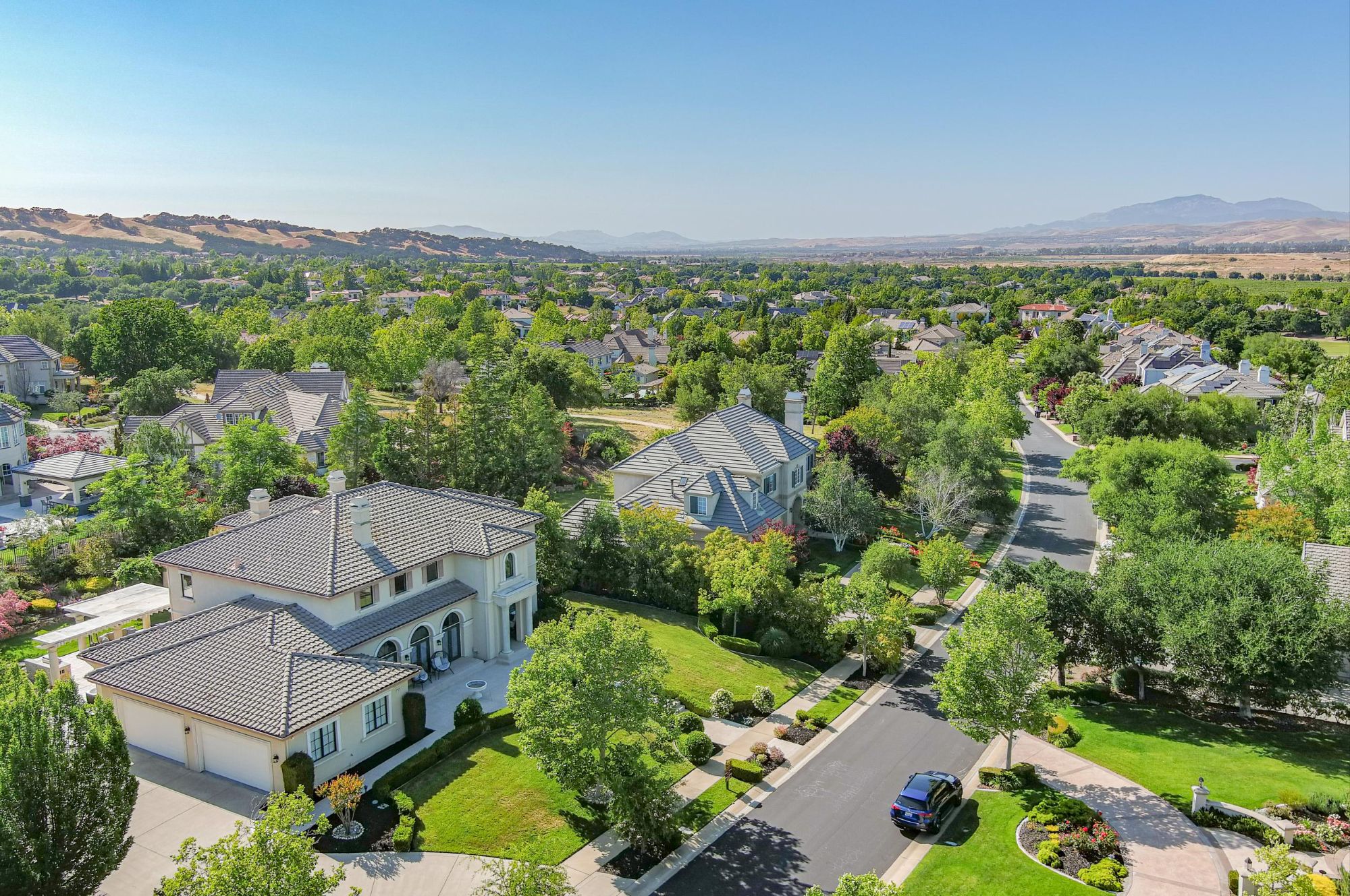
- Ruby Hill (Flat Usable Parcels): Average 0.35 to 0.75+ acres on the valley floor. Parcels are wide, flat, and pool-friendly with expansive lawns and outdoor loggias. Architecture features European Mediterranean, Tuscan, and French Country designs. For downsizers seeking single-level living, see our guide on Luxury Single-Story Homes in Pleasanton.
- Castlewood (Dramatic Hillside Acreage): Parcels span 0.50 to 2.0+ acres among mature oak groves. Yards are tiered and natural, featuring steep driveways, multi-level decks, and panoramic valley views. However, flat grass lawns are rare, and pool construction often requires extensive retaining walls and caisson engineering.
- The Preserve (Modern Custom Ridge Builds): Newer construction (late 1990s through 2000s) on 0.25 to 0.50-acre terraced parcels. Homes feature dramatic high ceilings, open-concept floor plans, and expansive rear viewing terraces engineered for low-maintenance outdoor living.
Carrying Costs: HOA Tiers, FAIR Plan Wildfire Insurance & Club Dues
An unvarnished underwriting of monthly holding overhead is essential at this price point:
The Hidden Line-Item Discrepancy:
- Proposition 13 Property Taxes: Resets to ~1.18% of purchase price across all three enclaves (approx. $33,000/year on a $2.8M home). Established tracts carry zero Mello-Roos CFD debt.
- Ruby Hill HOA Footprint: Base master association dues run $255 to $310/month. Certain sub-communities (such as The Villas or courtyard enclaves) carry secondary sub-HOA dues, pushing total dues to $400 to $800+ per month.
- Castlewood Insurance Exposure: Because Castlewood sits in a designated Wildland-Urban Interface (WUI) zone, private admitted insurers frequently decline fire coverage. Homeowners must combine a California FAIR Plan policy with a Difference in Conditions (DIC) wrap, running $5,000 to $12,000+ per year ($415 to $1,000/month).
For an itemized balance sheet model, review our complete report: The Hidden Costs of Buying a Luxury Home in Pleasanton.
Commute Realities: Valley Floor Convenience vs. Winding Ridge Roads
GPS navigation estimates routinely understate daily driving times from Pleasanton's hillside pockets:
- Ruby Hill: Sits on the valley floor with immediate access to Bernal Avenue, Highway 84, and the I-580/I-680 interchange. Silicon Valley commuters heading south over the Sunol Grade save 10 to 15 minutes each way compared to hillside locations.
- Castlewood: Navigating narrow, winding hillside roads out of Castlewood adds 10 to 15 minutes of slow driving before reaching Foothill Road or highway on-ramps, especially during winter rains or morning fog.
- The Preserve: Positioned in western Pleasanton with quick descent to Bernal Avenue and Foothill Road, balancing elevated views with streamlined highway access.
Explore our commuter-focused neighborhood breakdown: The Best Pleasanton Neighborhoods for Silicon Valley Families.
PUSD School Feeder Breakdown: Amador Valley High vs. Foothill High
In Pleasanton Unified School District (PUSD), high school attendance zones represent an enduring equity anchor. The three communities divide into distinct feeder paths:
Ruby Hill Feeder Alignment
High School: Amador Valley High School
Feeds Valley View Elementary, Pleasanton Middle School, and Amador Valley High School. Amador Valley High consistently ranks among the top public high schools in the Bay Area, featuring nationally acclaimed robotics and academic teams that attract relocating tech families from Palo Alto and Cupertino.
Castlewood & The Preserve Alignment
High School: Foothill High School
Both Castlewood and The Preserve feed into Foothill High School (along with Hearst or Lydiksen Elementary and Pleasanton Middle School). Foothill High boasts a 10/10 academic profile and 70%+ math proficiency, providing an exceptional college-preparatory environment.
For families evaluating independent options, review our complete directory: Top Private Schools Near Pleasanton (Quarry Lane, Athenian & BASIS).
Decision Matrix: Which Community Matches Your Life?
- Choose Ruby Hill If: You have school-aged children who want to ride bikes on flat streets; you prioritize 24/7 guarded security; you value an active country club social calendar; you want a flat backyard with a pool; and you desire zoning to Amador Valley High School.
- Choose Castlewood If: You crave wooded privacy, multi-acre mature oak grounds, and rustic hillside seclusion; you want private country club golf without gated community rules or high master HOA dues; and you are comfortable underwriting California FAIR Plan wildfire insurance.
- Choose The Preserve If: You want modern 2000s executive construction with open-concept floor plans; you prioritize panoramic valley views and daily hiking on Pleasanton Ridge trails; and you prefer low-maintenance living without country club overhead.
Comparing these enclaves against neighboring cities? Explore our regional report: Pleasanton vs. Danville, Alamo & Diablo Luxury Homes, and see Why Luxury Homes in Pleasanton Are a Smart Investment.
Frequently Asked Questions
What is the primary difference between Ruby Hill, Castlewood, and The Preserve in Pleasanton?
The primary difference lies in security, lifestyle infrastructure, and topography: Ruby Hill is Pleasanton's only 24/7 guard-gated community, offering flat estate lots ($2.8M–$5.5M+) and social life centered on its Jack Nicklaus golf club. Castlewood provides secluded, wooded hillside estates ($2.0M–$4.5M+) surrounding two 18-hole golf courses without a manned gate. The Preserve offers newer custom luxury construction ($2.4M–$3.8M) with dramatic valley views and immediate access to Pleasanton Ridge trails, without an on-site country club.
Which high schools serve Ruby Hill, Castlewood, and The Preserve?
Within the Pleasanton Unified School District (PUSD), Ruby Hill feeds into Amador Valley High School (along with Valley View Elementary and Pleasanton Middle School). In contrast, both Castlewood and The Preserve are zoned for Foothill High School. Both high schools rank among the top 20 public high schools in the Bay Area with 70%+ math proficiency.
How do HOA fees compare between Ruby Hill, Castlewood, and The Preserve?
Ruby Hill's master HOA dues range from $255 to $310 per month for 24/7 manned security and park maintenance, though properties in specific sub-HOAs pay $400 to $800+ per month. The Preserve carries moderate HOA fees of approximately $175 to $325 per month for common space and private gate automation. Castlewood has no master association; homeowners pay a modest road maintenance assessment of roughly $62.50 per month ($750 annually).
Does buying a home in Ruby Hill or Castlewood include country club membership?
No. Country club membership at both The Club at Ruby Hill and The Club at Castlewood is completely separate from residential property ownership. The real estate deed conveys no club access. Joining requires independent application, board vetting, initiation fees ($35,000 to $65,000+), and ongoing monthly dues ($950 to $1,450/month for golf).
What are the wildfire insurance realities for Castlewood vs. Ruby Hill vs. The Preserve?
Castlewood and parts of The Preserve sit in state-designated Wildland-Urban Interface (WUI) zones along the western ridgeline, where private admitted insurers frequently decline coverage, requiring homeowners to combine California FAIR Plan policies with a Difference in Conditions (DIC) wrap costing $5,000 to $12,000+ annually. Ruby Hill sits on the flat valley floor where standard admitted homeowners insurance is generally accessible ($2,200 to $3,500/year).
How does commute access compare between Ruby Hill, Castlewood, and The Preserve?
Ruby Hill offers the fastest vehicle access to the I-580 and I-680 interchange via Bernal Avenue and Highway 84, cutting 10 to 15 minutes off daily commutes to Silicon Valley. Castlewood requires driving narrow, winding hillside roads that add 10 to 15 minutes before reaching Foothill Road or I-680. The Preserve offers direct access down to Foothill Road and Bernal Avenue, providing a balance of hillside elevation and rapid highway access.
Which community is best for families with school-aged children?
Ruby Hill is widely considered the top choice for families with young children because its flat valley topography allows kids to safely ride bikes, walk to the community park, soccer fields, and swimming complex behind the security of 24/7 manned gates. Castlewood and The Preserve feature steeper topography and winding hillside streets with fewer sidewalks.
What are typical lot sizes in Ruby Hill vs. Castlewood vs. The Preserve?
Ruby Hill lots typically range from 0.35 to 0.75+ acres, offering flat, usable yard space ideal for custom swimming pools, sports courts, and outdoor kitchens. Castlewood lots are larger (0.50 to 2.0+ acres) but feature tiered, dramatic hillside topography with heritage oaks and natural slope. The Preserve features hillside parcels ranging from 0.25 to 0.50 acres designed to maximize panoramic valley views.
Categories
Recent Posts